49 Days After Death Calculator
Enter a date of death and get the Buddhist memorial dates used in Japan: the weekly services to the 49th day, the 100th day and the yearly memorials.
Recent
Your last 10 settings, saved only in this browser. Nothing is uploaded.
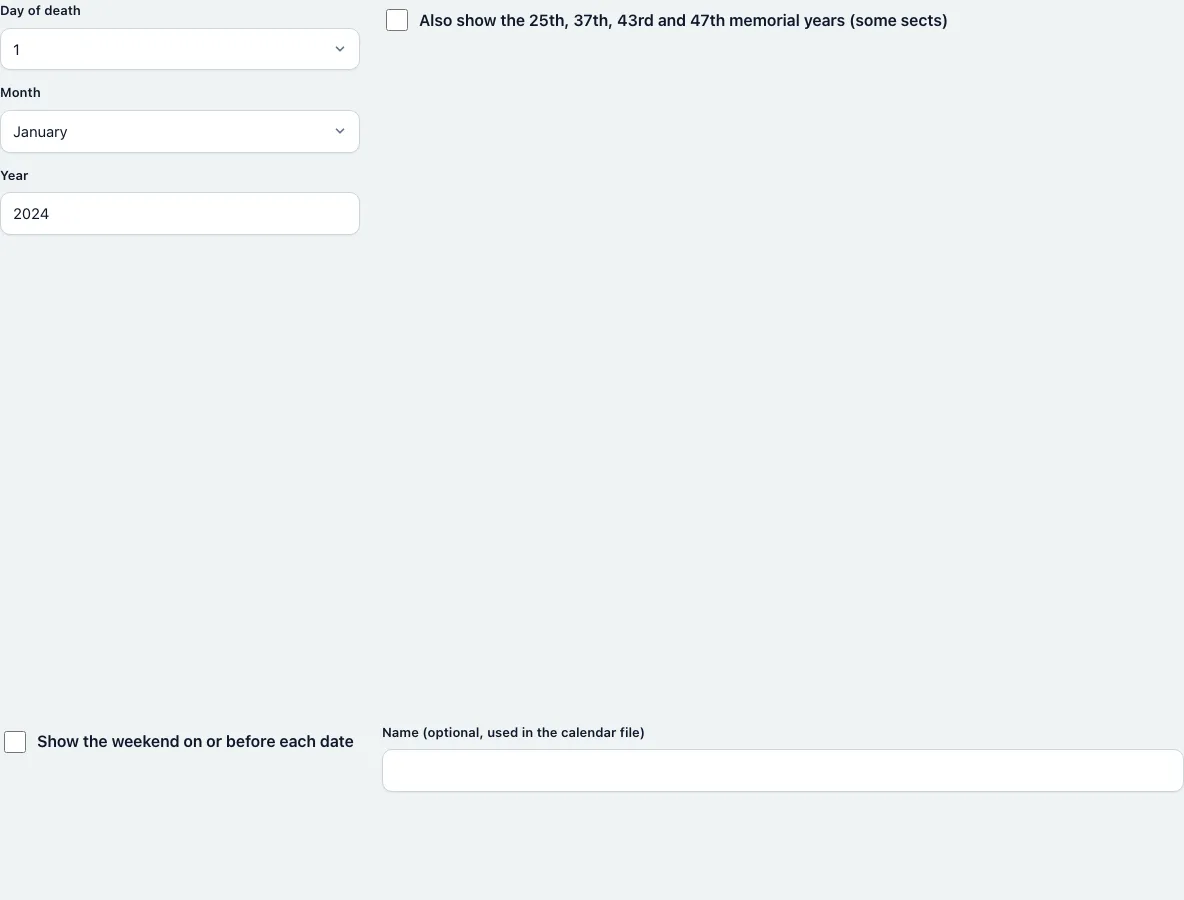
- Choose the day, the month and the year of death. An example date, 1 January 2024, is filled in, so replace it with your own.
- Read the three main results at the top: the 49th day, the 100th day and the date of the first memorial year.
- Check the table below. The first eight rows are the day counts, from the 7th day to the 100th day. The following rows are the year memorials from the first to the 100th.
- Tick “Show the weekend on or before each date” to add a column with the Saturday and Sunday before each date. Many families hold a service on a weekend before the exact day.
- Tick “Also show the 25th, 37th, 43rd and 47th memorial years” if your sect or temple holds these services.
- If the death was on 29 February, a list appears. In common years it chooses between 28 February and 1 March for the yearly memorials. The default is 28 February.
- Type a name if you want it in the calendar file. The name is only used in the downloaded file and the page does not keep it.
- Press “Copy the list” for plain text, “Print” for paper, or “Download calendar file (.ics)” to add the dates to your calendar app.
What are the 49 days after death?
In Buddhist belief the 49 days after a death are a time of transition for the deceased, and in Japan the family marks every seventh day with a service. The 49th day, called shijukunichi, is the most important of them and often ends the period of mourning. Other traditions count the days differently, and this page covers the Japanese system only. Readings of the services and the details of each ritual vary by school, so the table gives the common names.
How are the days counted?
The day of death is day 1. A death on 1 January 2024 has its 7th day on 7 January 2024, its 49th day on 18 February 2024 and its 100th day on 9 April 2024. These dates are the same as 6, 48 and 99 days after the date of death. If your family counts the date of death as day 0, each day count is one day later than shown, so add one day yourself.
What are the weekly services?
The services on days 7, 14, 21, 28, 35 and 42 are written 初七日, 二七日, 三七日, 四七日, 五七日 and 六七日 and read shonanoka, futanoka, minanoka, yonanoka, itsunanoka and munanoka. The 49th day, 四十九日, follows, and the 100th day is 百か日, hyakkanichi.
Which year memorials are there?
Year memorials are written 回忌 and counted the Japanese way, with the year of death as year 1. So the first memorial, 一周忌, is one year after the date, the third, 三回忌, is two years after, the seventh is six years, the thirteenth twelve, the seventeenth sixteen, the twenty-third twenty-two, the twenty-seventh twenty-six, the thirty-third thirty-two and the fiftieth forty-nine years after. The 100th memorial is 99 years after.
Why can the date differ from your temple’s?
Families and temples often move a service to a weekend, usually the one before the exact day, because relatives can then attend. Customs also differ by region and sect. The regional practice around the 7th week called makura-bi is not modelled, so confirm every date with your temple.
Frequently asked questions
Is the 49th day 49 days after the death?
No. In Japan the day of death is day 1, so the 49th day is 48 days after the date of death. A death on 1 January 2024 gives the 49th day on 18 February 2024.
What happens on the 49th day?
In Japanese Buddhism it is the most important service of the weekly series and is often the day the period of mourning ends. Ask your temple what its custom is, because it varies.
Does the calculator work for the Tibetan bardo of 49 days?
It uses the Japanese counting and the Japanese service names. Other traditions may count from another day or hold other services, so use the table only as a starting point there, and ask a teacher of your own tradition for the correct dates.
Can I move a date to the weekend?
Yes. Tick the weekend option to see the nearest Saturday and Sunday on or before each date. The choice belongs to the family and the temple.
Are the dates sent anywhere?
No. The dates are worked out in your browser and nothing is uploaded. The page does not store the date of death or the name, and the calendar file is created on your own device.
- Yahrzeit Calculator: death anniversaries by the Hebrew calendar, with a calendar file.
- Age at Death Calculator: work out the age at death from two dates.
- Hebrew Date Converter: convert a date to the Hebrew calendar.
- Julian to Gregorian Converter: convert old dates between the two calendars.
- Ahnentafel Number Calculator: number the ancestors in your tree.
- Soundex Calculator: match name spellings in old records.
- GEDCOM Viewer: read the dates in a GEDCOM file.