Cousin Calculator
Choose how many generations you and the other person are below your common ancestor, or look a cousin up by degree and times removed. You get the name, a family diagram and the expected shared DNA.
Recent
Your last 10 settings, saved only in this browser. Nothing is uploaded.
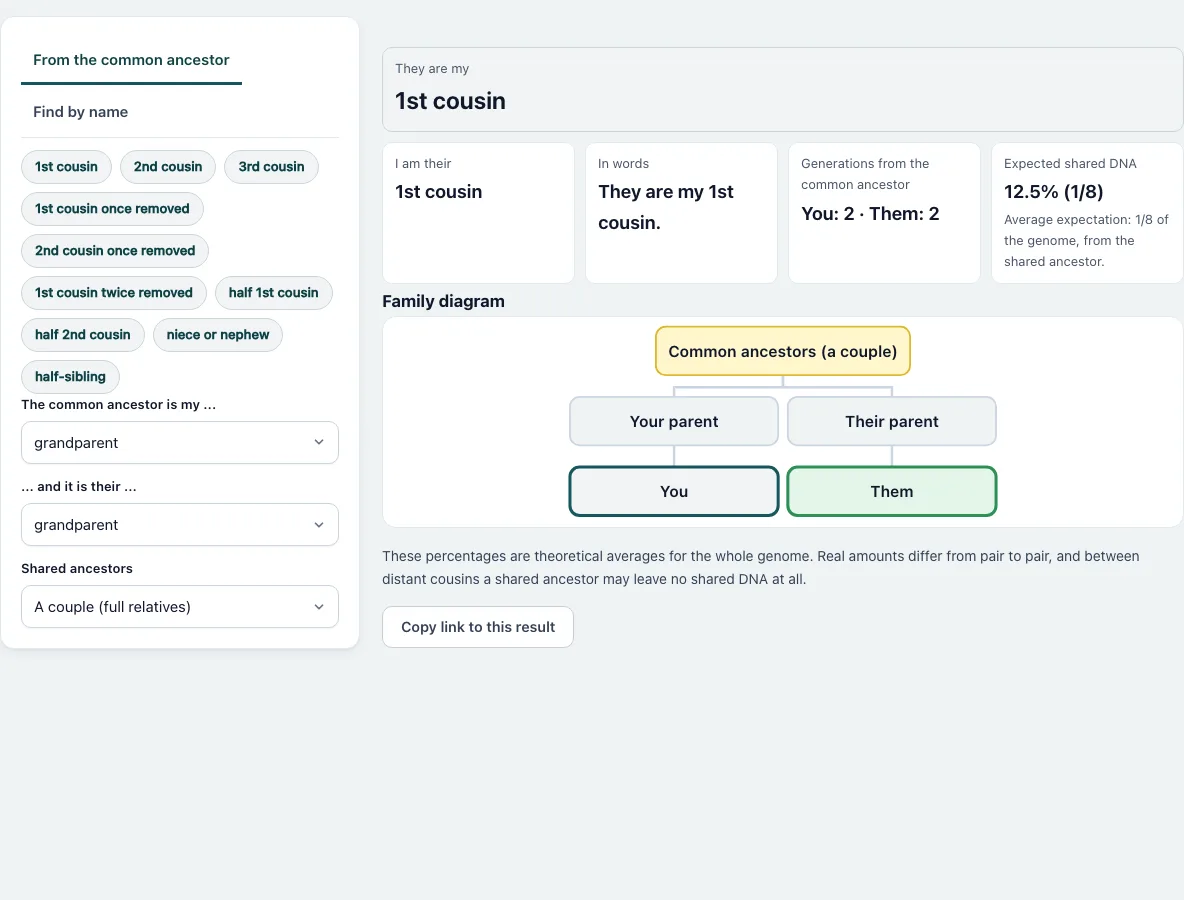
How to use the cousin calculator
- Open the tab “From the common ancestor”. Under “The common ancestor is my …” choose how far back your own shared ancestor is: parent, grandparent, great-grandparent and so on up to 8x great-grandparent.
- Under “… and it is their …” choose the same for the other person. If you are the common ancestor yourself, pick “myself”; for the other person the matching choice is “themselves”.
- Under “Shared ancestors” keep “A couple (full relatives)” when you share both grandparents or great-grandparents. Choose “Only one person (half relatives)” when only one of them is shared.
- Read the tiles: “They are my”, “I am their”, “In words”, “Generations from the common ancestor” and “Expected shared DNA”. The diagram below shows the two lines of descent.
- To start from a name, press one of the chips (1st cousin, 2nd cousin, half 1st cousin and others) or open “Find by name”.
- There choose “Cousin degree” (1st to 10th), “Times removed” (0 to 10) and “Their generation compared with mine”. With 0 removals the generation is the same as yours.
- Press “Copy link to this result” to share the exact answer. The choices are stored in the link. Everything is calculated in your browser, so nothing you enter is sent anywhere and the page works offline once loaded.
How are cousin degree and times removed worked out?
Count the generations from each person up to the nearest common ancestor. Call them a (you) and b (them). The smaller number minus one is the cousin degree, and the difference between the two numbers is the number of times removed. The person with the larger number is the younger generation. For a = 2 and b = 2, both of you are grandchildren of the shared ancestors, so you are 1st cousins. For a = 3 and b = 4 the degree is 2 and the removal is 1: 2nd cousins once removed.
What is a third cousin?
A third cousin shares a 2x great-grandparent with you: a = b = 4. The calculator shows 3rd cousin, 1/128 and 0.78125% as the average expected DNA.
What is a half cousin?
A half cousin shares only one common ancestor instead of a couple, usually because a grandparent had children with two partners. Half 1st cousins (a = b = 2) share an expected 6.25%, which is 1/16, half of the 12.5% of full 1st cousins.
How much DNA do cousins share?
For full relatives the average expectation is (1/2) to the power a + b - 1 of the genome. For half relatives it is (1/2) to the power a + b. A 1st cousin once removed (a = 2, b = 3) gives 6.25%, and a 2nd cousin once removed (a = 3, b = 4) gives 1.5625%. These are theoretical averages; real pairs vary, and distant cousins may share no DNA from the common ancestor at all.
What if one of you is the ancestor or a sibling?
When a number is 0 the person is the other’s ancestor or descendant: a parent, grandparent, child and so on. When the smaller number is 1 there are no cousins: 1 and 1 are siblings, 1 and 2 are aunt or uncle and niece or nephew, 1 and 3 great-aunt or great-uncle and grandniece or grandnephew. Expected shared DNA is only a theoretical average for the relationship; real amounts vary from person to person, so it cannot prove or disprove a relationship by itself.
How this tool works and where the numbers come from
Count the generations a and b from each person up to the nearest common ancestor. The cousin degree is the smaller number minus one and the removal is the difference. Expected shared DNA is (1/2) to the power a + b - 1 for full relatives, a theoretical average from Wright’s path counting; real pairs vary.
Sources
Frequently asked questions
What is the difference between a half cousin and a cousin once removed?
Half describes how many ancestors you share: only one person instead of a couple. Removed describes a generation gap between you and the cousin. The two can combine, as in “half 1st cousin once removed”.
Is a second cousin the child of a first cousin?
No. The child of your 1st cousin is your 1st cousin once removed. A 2nd cousin shares great-grandparents with you and is in your own generation.
Does the calculator work for aunts, uncles and siblings?
Yes. Choose 1 for one person and 2 for the other (for example parent and grandparent) to get an aunt, uncle, niece or nephew name. Both at 1 gives sibling.
Can I trust the DNA percentage?
Treat it as an average over many pairs, not a prediction for yours. The same relationship can share noticeably more or less DNA, and a shared ancestor does not guarantee shared DNA at distant degrees.
What is the largest relationship it can name?
The ancestor lists go up to 8x great-grandparent and the name lookup covers 10th cousins and up to 10 times removed.
Is anything uploaded?
No. The calculation and the diagram run in your browser, and the link only holds your choices.
- Cousin Chart: see every cousin name from 1st to 9th cousin in one table.
- First Cousin Once Removed: one named relationship explained from both sides.
- Relationship Calculator: work out how two people in a family tree are related.
- Relationship Chart: the full chart of family relationships.
- Inbreeding Coefficient Calculator: measure how related two parents are.
- Kinship Terms: relationship words in other languages.
- Ahnentafel Number Calculator: numbers for your direct ancestors.
- How Many Ancestors Calculator: how the ancestor count grows by generation.
- Gedcom Viewer: open a family tree file to find the common ancestor.