First Cousin Once Removed
See who a first cousin once removed is, drawn as a family diagram, and swap the viewpoint to see it from their side. Change degree and removal for any cousin.
Recent
Your last 10 settings, saved only in this browser. Nothing is uploaded.
How to find out who is your first cousin once removed
- Read the heading “Your 1st cousin once removed” and the sentence under it. It names both possibilities: your 1st cousin’s child, or your parent’s 1st cousin.
- Press a chip to jump to another relationship, such as “2nd cousin once removed” or “1st cousin twice removed”.
- Or set “Cousin degree” (1st to 10th) and “Times removed” (0 to 10) yourself.
- Under “Who is younger?” choose whether they are younger than you or older than you. With 0 times removed, both of you are in the same generation.
- Press “Swap viewpoint” to see the relationship from their side. The tiles “Seen from you” and “Seen from them” give the wording for each of you.
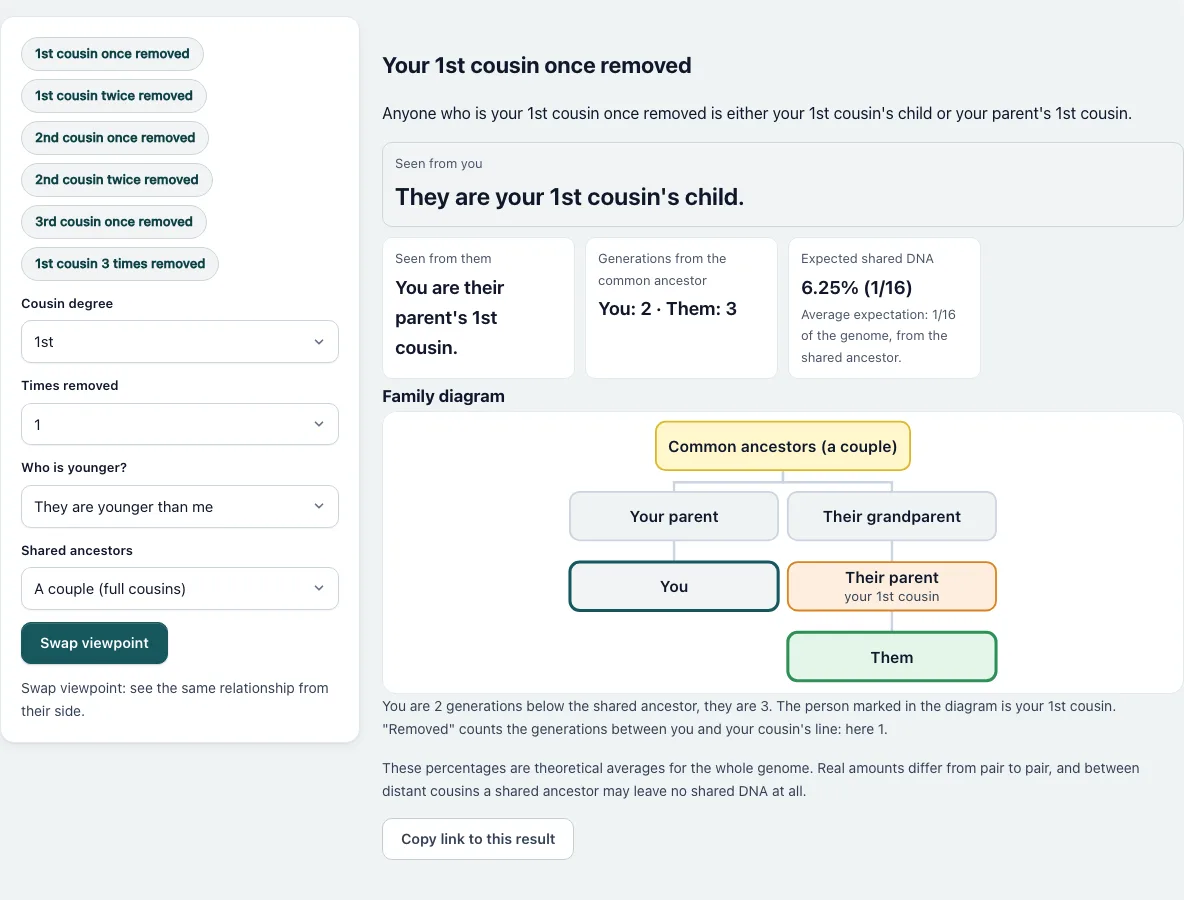
- Look at the family diagram. It shows the common ancestors at the top, your line on the left and their line on the right. The orange box is the person who is your cousin, or their cousin when they are older.
- Under “Shared ancestors” choose “One person (half cousins)” if you share only one ancestor.
- Read “Generations from the common ancestor” and “Expected shared DNA” for the numbers behind the name. The line under the diagram says how many generations each of you is below the shared ancestor.
- Press “Copy link to this result” to share the exact relationship.
What is a first cousin once removed?
A first cousin once removed is one generation away from being your first cousin. Your first cousins are the children of your aunts and uncles. Their children are your first cousins once removed, and your parents’ first cousins are too. In the default diagram you are 2 generations below the common ancestors, who are your grandparents, and the other person is 3 generations below them, so those ancestors are their great-grandparents.
What is a second cousin once removed?
A second cousin once removed is the child of your second cousin, or the second cousin of your parent. Second cousins share great-grandparents. The calculation gives you 3 generations and them 4. The expected shared DNA is 1.5625%, which is 1/64.
What does “once removed” mean?
“Removed” counts generations. Once removed means one generation up or down; twice removed means two, for example your first cousin’s grandchild. The degree stays the same, and only the generation of one person changes.
How much DNA does a first cousin once removed share?
For full cousins, the average expectation is (1/2) to the power of the total generations minus one. For 2 and 3 generations that is 1/16, or 6.25%. This is an average over many pairs and real amounts differ. With a shared ancestor who is only one person, the figure is halved: a half first cousin once removed averages 3.125%.
How can I work it out without the page?
Count the generations from you up to the nearest common ancestor, and the same for them. The smaller count minus one is the degree, and the difference between the counts is the number of times removed. The person with the larger count is in the younger generation.
Is the name the same for both people?
Yes. They are your first cousin once removed and you are theirs. Only the wording changes: “your cousin’s child” and “their parent’s cousin”.
Frequently asked questions
Is a first cousin once removed the child of a first cousin?
Yes, that is one of the two cases. The other is your parent’s first cousin. Both are the same relationship seen from different generations.
Is my second cousin the same as a first cousin once removed?
No. A second cousin is in your generation and shares great-grandparents. A first cousin once removed is in an adjacent generation and shares a different pair of ancestors.
Who is a first cousin twice removed?
Your first cousin’s grandchild, or your grandparent’s first cousin. The chip “1st cousin twice removed” shows it with a diagram.
Can a first cousin once removed be the same age as me?
Yes. Generation is not age. A cousin once removed can be older or younger than you in years, whichever generation they belong to.
What is the difference between half and removed?
Half means only one ancestor is shared instead of a couple. Removed means a generation gap. The two can combine in one name.
Can I use this for a half relationship?
Yes. Choose “One person (half cousins)” under “Shared ancestors”.
Does this upload my information?
No. Only the numbers you choose are used, and they stay in your browser.
- Cousin Calculator: work from the common ancestor to the name.
- Cousin Chart: all cousin degrees and removals in one table.
- Relationship Calculator: relationships between two people in a tree.
- Relationship Chart: the chart of family relationships.
- Inbreeding Coefficient Calculator: how related two parents are.
- Kinship Terms: relationship words in other languages.
- Ahnentafel Number Calculator: numbers for direct ancestors.
- How Many Ancestors Calculator: ancestors per generation.
- Gedcom Viewer: open a family tree file.