Hebrew Date Converter
Pick a Gregorian date to get the Hebrew date, or pick a Hebrew date to get the Gregorian one. The page also lists the same Hebrew date in the next years.
Recent
Your last 10 settings, saved only in this browser. Nothing is uploaded.
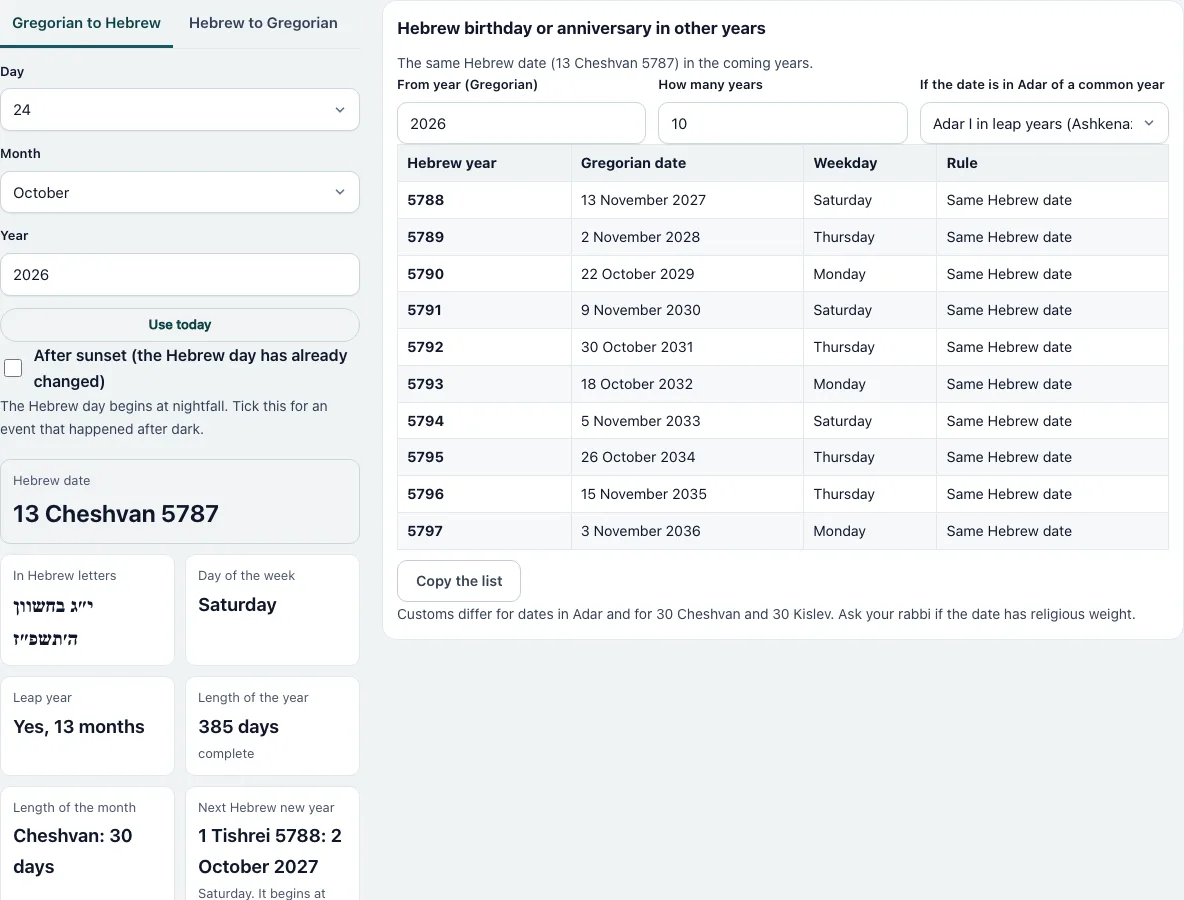
- Open the tab “Gregorian to Hebrew”. The fields start on today’s date.
- Choose the day and month in the lists and type the year (1 to 9999). The result updates as you change a field.
- Tick “After sunset” if the event happened after dark. The Hebrew day begins at nightfall, so the result then moves to the next Hebrew date.
- Read the Hebrew date in English and in Hebrew letters, the weekday and the year facts. Press “Copy result” to copy one line of text.
- To go the other way, open “Hebrew to Gregorian”. Choose the Hebrew month, the day and the Hebrew year (3761 to 13759). Adar II is only offered in leap years, and the day list follows the length of the month you chose.
- Press “Use today” in either tab to return to today’s date.
- Scroll to “Hebrew birthday or anniversary in other years”. Set the first Gregorian year and how many years you want (1 to 50). The table shows the Gregorian date and the weekday for each year.
- If your date is in Adar of a common year, choose how leap years are handled in the list “If the date is in Adar of a common year”, then press “Copy the list” to take the table with you.
How do you convert a Gregorian date to a Hebrew date?
The converter counts days. It turns the Gregorian date into a day number, finds the Hebrew year that contains that day and then the month and day inside it. The calendar used is the fixed arithmetic Hebrew calendar. Result for 23 April 2024: 15 Nisan 5784, a Tuesday. Result for 1 January 2000: 23 Tevet 5760.
Why does “after sunset” change the date?
A Hebrew day runs from nightfall to nightfall. A birth at 9 p.m. on 2 October 2024 falls on 1 Tishrei 5785, not 29 Elul 5784. The tool does not know your sunset time, so you tick the box yourself.
Which Hebrew months does a year have?
A common year has 12 months and a leap year has 13, with an extra Adar. In a leap year the months are Adar I and Adar II. Seven of every 19 years are leap years. 5784 is a leap year of 383 days, 5785 is a common year of 355 days. Year lengths are 353, 354 or 355 days (common) and 383, 384 or 385 days (leap), called deficient, regular and complete.
How are Hebrew letters used for numbers?
Each letter has a value, so the day and the year are written as letters. 15 is written ט״ו and 16 is ט״ז, because the usual letters for 15 and 16 would spell a name of God. The year 5784 is written ה׳תשפ״ד, where ה׳ stands for the 5,000. A single letter gets a geresh (׳); a longer number gets a gershayim (״) before its last letter.
How are old dates handled?
The tool uses the Gregorian calendar for every date, also for years before the Julian calendar was replaced. A date from a historical record may be Julian and needs converting first.
What happens on a Hebrew birthday in other years?
The table repeats the Hebrew date. Rules for the awkward cases: 30 Cheshvan and 30 Kislev fall on the last day of the month when that month has 29 days; 30 Adar I becomes 30 Shevat in a common year; Adar II becomes Adar in a common year. A date in a common-year Adar can be kept in Adar I (the default), moved to Adar II or listed twice in a leap year, because customs differ.
How this tool works and where the numbers come from
The Gregorian date becomes a day number; the tool finds the Hebrew year that contains it and then the month and day, using the fixed arithmetic Hebrew calendar. A Hebrew day runs from nightfall, so a birth after sunset takes the next day’s date; you tick that box yourself.
Sources
Frequently asked questions
Is this a Hebrew calendar converter as well as a date converter?
Yes. It converts single dates in both directions, and it shows the month and year facts of the calendar. It does not print a full calendar page or holiday list.
Is the Hebrew year the same as the Gregorian year plus 3760?
Only between 1 January and the Hebrew new year. The Hebrew year changes on 1 Tishrei, in September or October. So 3 October 2024 is already in 5785, while 2 October 2024 is in 5784.
Do I tick “After sunset” for a birth or a death?
Tick it when the event happened after nightfall. The Hebrew date is then the one of the next civil day. If you are unsure of the time, check both results.
Can I convert a date before 1582?
Yes, from year 1 onwards, but the Gregorian date is a proleptic one, as if the Gregorian rules had always applied. Dates from historical records may be Julian dates.
Does the page store the date I enter?
No. The calculation is done by the script on this page, in your browser. Nothing is uploaded, and the page does not keep what you enter. You can also use it without a connection once it has loaded.
- Yahrzeit Calculator: the anniversary of a death by the Hebrew date, with a calendar file.
- Julian to Gregorian Converter: convert old records written in the Julian calendar before using this page.
- Age at Death Calculator: work out how old someone was from two dates.
- Ahnentafel Number Calculator: number the ancestors in your tree.
- 49 Days After Death Calculator: Buddhist memorial dates from a date of death.
- Soundex Calculator: match name spellings in old records.
- GEDCOM Viewer: read the dates in a GEDCOM file.