Inbreeding Calculator
Choose how the parents are related, or edit their common ancestors, and get the child's inbreeding coefficient with every step shown. Or open a family tree file and read it for any person.
Recent
Your last 10 settings, saved only in this browser. Nothing is uploaded.
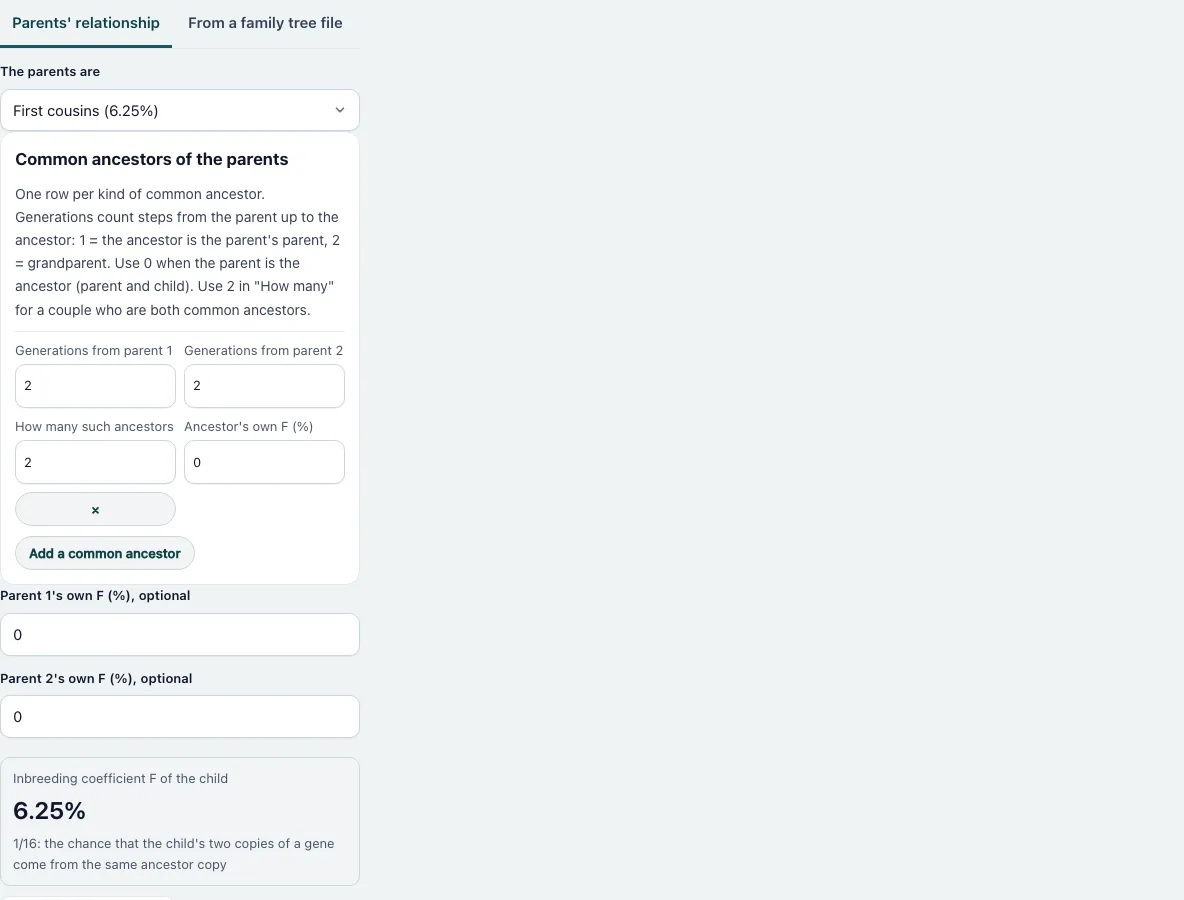
- On the “Parents’ relationship” tab, open “The parents are” and choose a case. The list includes parent and child, full siblings, half siblings, uncle and niece, double first cousins, first cousins, first cousins once removed and second cousins.
- Read the child’s inbreeding coefficient F at the top, then the coefficient of relationship of the parents below it.
- Check “The working, step by step”: each row shows how many ancestors, the generations from each parent and the contribution of that row.
- To enter your own case, edit the numbers in the rows or press “Add a common ancestor”. Enter the generations from parent 1 and parent 2 up to the ancestor, how many such ancestors there are (2 for a couple), and the ancestor’s own F in percent if the ancestor was inbred.
- If a parent was inbred, fill in “Parent 1’s own F (%)” or “Parent 2’s own F (%)”. This changes the coefficient of relationship, not F.
- To use a tree, open “From a family tree file”. Drop a .ged file, press “Try the sample family” or press “Try a cousin-marriage example”.
- Pick “Person A”. F for that person appears with their parents and the main common ancestors of those parents.
- Pick “Person B” to see the coefficient of relationship between the two people.
- Use “Copy the result” on the first tab to copy a one-line summary.
What is the inbreeding coefficient?
The inbreeding coefficient F is a number from 0 to 1, usually written as a percentage. It is the probability that a person receives the same copy of a gene from both parents because both inherited it from one common ancestor. A child of unrelated parents has F = 0. A child of full siblings or of a parent and child has F = 25%.
How do you calculate the inbreeding coefficient?
Wright’s path formula adds one term for every common ancestor of the parents: (1/2)^(n1 + n2 + 1) x (1 + F of the ancestor). Here n1 and n2 are the generations from each parent up to that ancestor. First cousins have two common ancestors, their grandparents, with n1 = n2 = 2. Each gives (1/2)^5 = 1/32, so F = 2/32 = 6.25%. Full siblings give 2 x (1/2)^3 = 25%, and half siblings, who share one ancestor, give 12.5%.
What are the inbreeding coefficients for common relationships?
Parent and child 25%, full siblings 25%, half siblings 12.5%, uncle and niece 12.5%, double first cousins 12.5%, first cousins 6.25%, first cousins once removed 3.125%, second cousins 1.5625%. The coefficient of relationship of the parents is twice F when neither parent is inbred.
How does the family tree mode work?
It uses the recursive kinship method. The kinship of a person with themself is (1 + F)/2. The kinship of two different people is the average of the kinships of the older one with the younger one’s father and mother. F of a person is the kinship of their father and mother. Unknown parents are treated as unrelated, adopted and foster links are skipped, and parent links that form a loop are ignored. In the cousin-marriage example Martin has F = 6.25%, and Paul, whose parents are siblings who are both children of first cousins, has F = 28.125%.
What are the limits?
The numbers cover only what is in the file. Missing ancestors lower F. They are expected values, not a medical risk figure.
How this tool works and where the numbers come from
Wright’s path formula adds one term for every common ancestor of the parents, (1/2)^(n1 + n2 + 1) x (1 + F of the ancestor), where n1 and n2 are the generations up to that ancestor. For a family tree the tool uses the recursive kinship method. Missing ancestors lower the result, and it is an expected value, not a medical risk figure.
Sources
Frequently asked questions
What is the inbreeding coefficient of first cousins?
For the child of first cousins F is 6.25%, or 1 in 16. The parents themselves are 12.5% related.
Is the inbreeding coefficient the same as the coefficient of relationship?
No. F belongs to a person and measures how related their parents are. The coefficient of relationship measures how related two people are. For parents who are not inbred, r equals twice the child’s F.
What if a common ancestor was inbred too?
Enter that ancestor’s own F in percent in the row. Each term is multiplied by (1 + F of the ancestor), so an inbred ancestor raises the result.
Why is F zero for a person in my file?
F is zero when the file does not show two birth parents for that person, or when no ancestor appears on both sides. Add the missing parents to the file and check again.
Does it follow adoptions?
No. Adoption and foster links carry no genes, so the calculator treats an adopted person as having no known birth parents.
What does an F of 25% mean?
It means that, on average, a quarter of the child’s gene positions are expected to carry two copies that descend from the same ancestral copy. It is an average over all genes and does not predict a single trait.
Is my file uploaded?
No. The file is read and calculated in your browser.
These pages cover the same relationships from other angles.
- Relationship Calculator: name how two people are related.
- Relationship Chart: a chart of every common relationship.
- Cousin Calculator: the degree and removal of two cousins.
- Cousin Chart: cousins by degree and removal.
- Kinship Terms: relative names in other languages.
- How Many Ancestors Calculator: count ancestors by generation, and see why shared ancestors reduce the count.
- Ahnentafel Number Calculator: number your ancestors.
- GEDCOM Validator: check a file for broken links before you use it.
- GEDCOM Viewer: browse the people in a file.