Julian to Gregorian Converter
Convert a date from the Julian to the Gregorian calendar or back, with the weekday, the gap in days and the double year used in old English records.
Recent
Your last 10 settings, saved only in this browser. Nothing is uploaded.
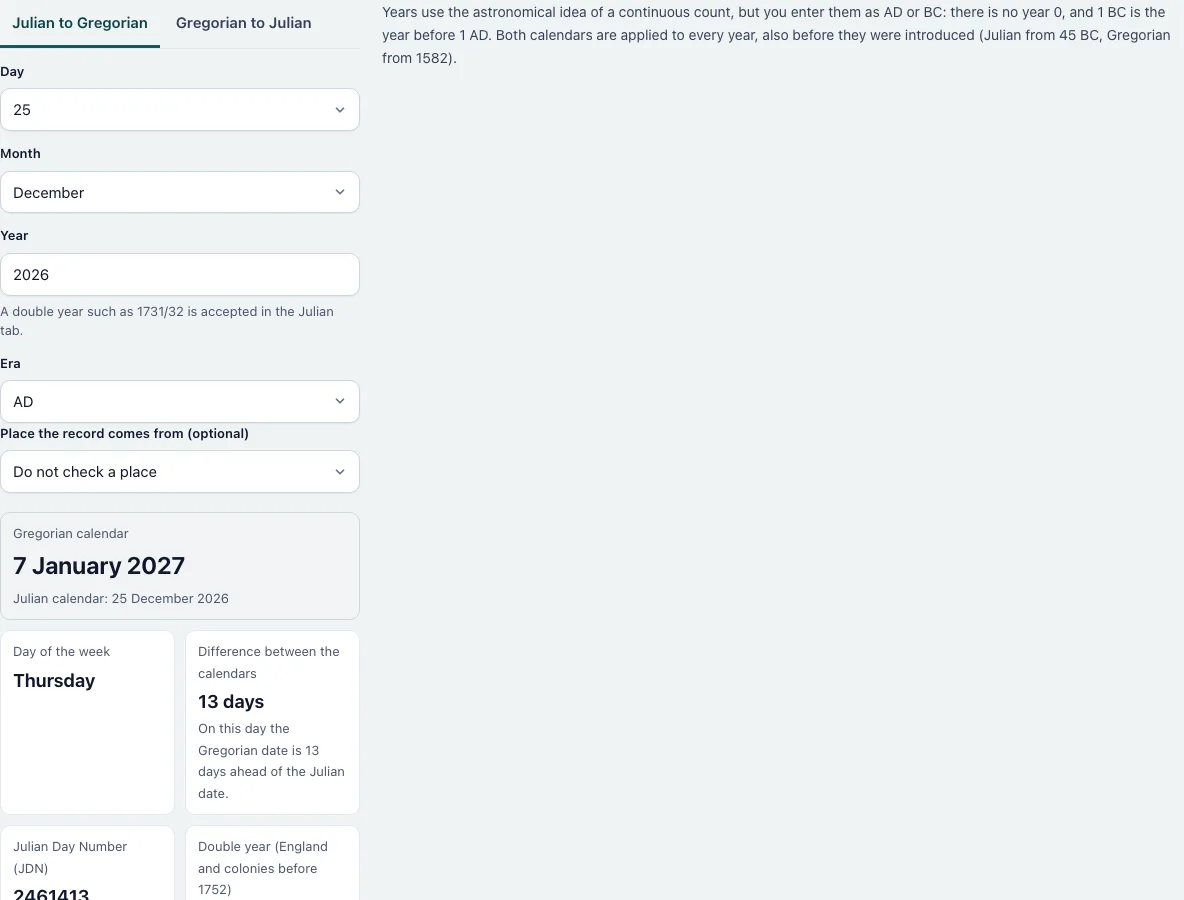
- Open the tab “Julian to Gregorian” if your source uses the old calendar, or “Gregorian to Julian” for the other direction.
- Choose the day and month, and type the year. In the Julian tab you may type a double year, for example 1731/32. The tool then uses the later year, 1732.
- Choose AD or BC. There is no year 0: 1 BC is followed by 1 AD.
- Optional: choose the place the record comes from. The tool then tells you whether the date lies before or after the change to the Gregorian calendar there.
- Read the converted date at the top. Below it are the weekday, the difference between the calendars in days, the Julian Day Number and, where it applies, the double year.
- Choose “Copy result” to copy one line, for example for a research log.
- Use the two tables at the bottom for reference: the first lists when places switched, the second shows how many days the Gregorian calendar is ahead from each century.
- Switch tabs to check the result in the other direction: the same day is shown in both calendars.
- If you see a message about a missing 29 February, the year is not a leap year in that calendar. 1900 is a leap year in the Julian calendar but not in the Gregorian one.
How do you convert a Julian date to a Gregorian date?
Every day has a Julian Day Number, a count of days that both calendars share. The converter turns the date you enter into that number and then writes the number out in the other calendar. For the Julian date 25 December 1900 the answer is 7 January 1901. For 4 October 1582 the answer is 14 October 1582.
How many days apart are the two calendars?
The Julian calendar has a leap year every four years. The Gregorian calendar skips the leap day in century years that 400 does not divide. The gap therefore grows: 10 days in 1582, 11 days from March 1700, 12 days from March 1800, 13 days from March 1900 and 14 days from March 2100. The tool computes the gap for the date you enter.
Why were 29 February 1900 and 1700 different?
The Julian calendar counts every fourth year as a leap year, so 1700, 1800 and 1900 had 29 February there. The Gregorian calendar leaves the leap day out of those years. That is why 29 February 1900 Julian is 13 March 1900 in the Gregorian calendar, and why you cannot enter 29 February 1900 in the Gregorian tab.
What is the Julian Day Number?
The Julian Day Number (JDN) counts days from 1 January 4713 BC in the Julian calendar. It is a tool of astronomers and has nothing to do with the Julian calendar, apart from its name. The number for 1 January 2000 is 2451545.
What is a double year such as 1731/32?
In England, Wales, Ireland and the colonies the year began on 25 March until 1751. A date from 1 January to 24 March was written with both years, so 12 February 1731/32 is 12 February 1732 by modern counting. The tool shows this for Julian dates up to 1751. Scotland began its year on 1 January in 1600.
When did countries switch to the Gregorian calendar?
Spain, Portugal, most Italian states and Poland-Lithuania changed on 15 October 1582, France on 20 December 1582, Protestant German states, Denmark and Norway on 1 March 1700, Britain and its colonies on 14 September 1752 and Sweden on 1 March 1753. Russia followed on 14 February 1918 and Greece on 1 March 1923 for civil records. Regions often differed.
How this tool works and where the numbers come from
The date is turned into a Julian Day Number, a count of days both calendars share, and written out in the other calendar. The Julian calendar has a leap year every fourth year; the Gregorian skips the leap day in century years that 400 does not divide, so the gap grows from 10 days in 1582.
Sources
Frequently asked questions
Is the Julian date always behind the Gregorian one?
From 1 March 300 AD onward the Julian date is behind, by 1 day at first and by 10 to 14 days from 1582 to 2100. The two calendars agree from 1 March 200 AD to 28 February 300 AD. Before that the Julian date is ahead.
Why does my record show two years?
A date such as 1731/32 comes from the time when the year began on 25 March. The first year is the one used then, and the second is the year as counted from 1 January. Genealogists use the double year to avoid mistakes of a year in baptisms, marriages and burials from January to March.
Which calendar was used in my country on my date?
Pick the place in the list. The tool compares your date with the day that place changed calendars and says whether the record was probably Julian. Local variation is common, so treat this as a hint.
Can I enter BC dates?
Yes, from 1 BC to 4713 BC. Both calendars are applied backwards to those years, which is a convention that astronomers and historians use.
Is anything uploaded?
No. The conversion is done by a script on this page, in your browser, and the page keeps nothing you enter. You can use it offline once it has loaded.
- Hebrew Date Converter: convert a date to the Hebrew calendar after fixing the Julian date.
- Yahrzeit Calculator: death anniversaries by the Hebrew calendar.
- Age at Death Calculator: the age from a birth and a death date.
- 49 Days After Death Calculator: memorial dates from a date of death.
- Ahnentafel Number Calculator: number the ancestors in your tree.
- Soundex Calculator: match name spellings in old records.
- GEDCOM Viewer: see the dates in a GEDCOM file.