Kinship Terms
Pick a language and see the family word for each of 99 relatives, or compare up to four languages side by side. Entries show whether they come from a cited source or are still unconfirmed.
Recent
Your last 10 settings, saved only in this browser. Nothing is uploaded.
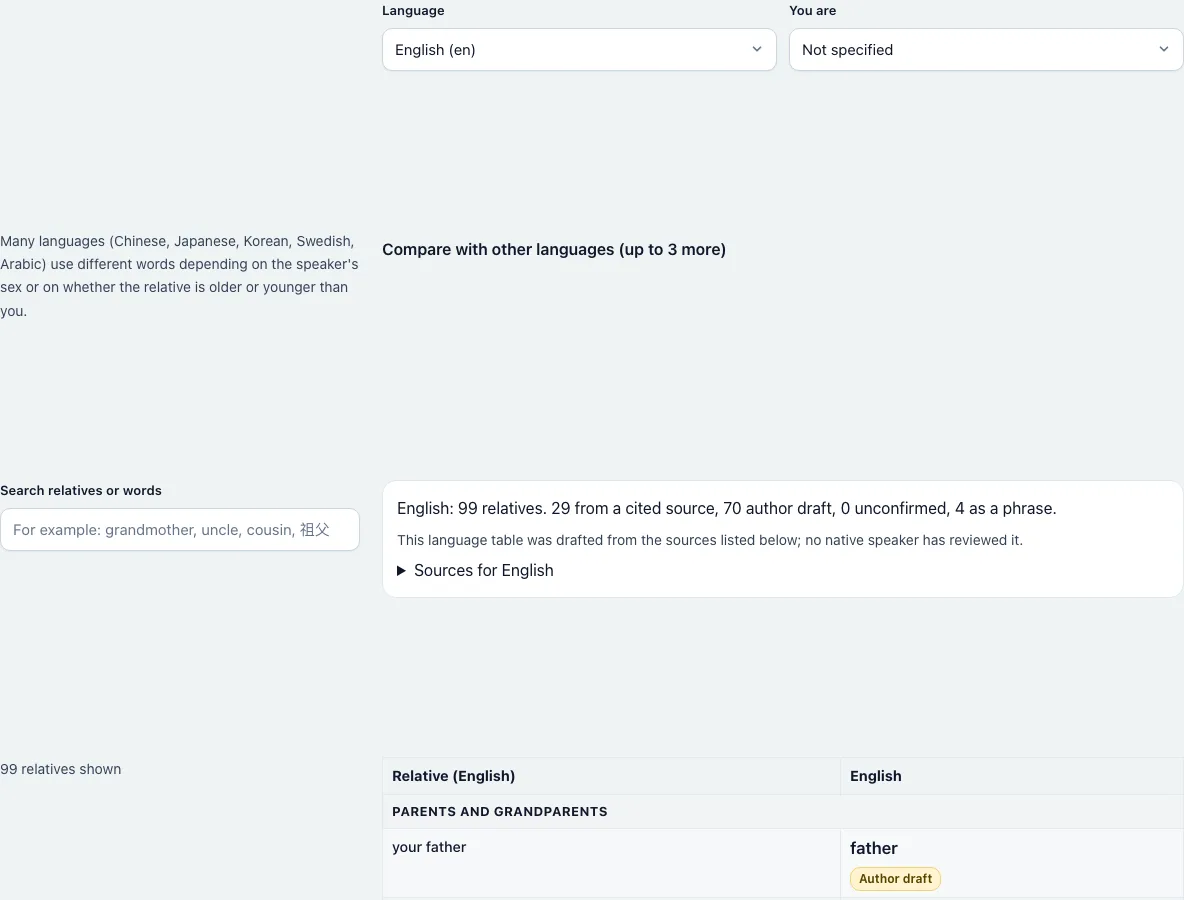
- Choose a language under “Language”. The table shows the English description of each relative and the term in that language.
- Set “You are” to a man or a woman if the language uses speaker-dependent words. With “Not specified” the page shows every possible form where the word depends on sex.
- Type in “Search relatives or words” to narrow the list. You can search the English description (grandmother, uncle) or a word in the chosen language.
- Press “Show all” under the first group of relatives to see every group: grandparents, children, siblings, aunts and uncles, cousins, in-laws and step relatives.
- Open “Compare with other languages” and tick up to three more languages to see them next to the first one.
- Read the small labels under each term. “Unconfirmed”, “Author draft” and “Cited source” say where the word comes from. “Phrase” means no single word is known and the term is a description. “Depends” means the word changes with your sex or with age.
- Open “Sources” under the language summary to read the sources used and the date each was read.
- Use “Copy as table” to paste into a spreadsheet, “Copy as CSV” for comma-separated text or “Download CSV” for a file.
What are kinship terms?
Kinship terms are the words a language has for relatives. English uses few: uncle, aunt, cousin. Other languages split them. Many have separate words for a father’s brother and a mother’s brother, or for an older and a younger sibling. This lookup lists 99 relatives and the word for each.
Which kinship terms depend on the speaker?
In Korean an older brother is 형 for a man and 오빠 for a woman, and an older sister is 누나 for a man and 언니 for a woman. Chinese, Japanese, Swedish and Arabic also distinguish relatives by side of the family or relative age. Setting “You are” shows those forms; leaving it unset shows all of them with a “Depends” label.
How reliable are the terms?
Not all entries are checked, and none has been reviewed by a native speaker. For English, German, French, Spanish, Swedish, Russian, Japanese, Korean, Simplified Chinese and Traditional Chinese the tables were drafted from published sources such as Wikipedia and a national language institute, listed under each language. The other ten languages are drafts, and every entry is marked unconfirmed. In the sourced languages some entries are still marked unconfirmed because no source covered them, and some are an author draft of basic vocabulary.
What do phrases mean in the table?
Where a language has no single word for a relative, the table builds a description from other words, such as “father’s first cousin’s son”. That entry is marked as a phrase. Phrases are correct but may not be what people actually say.
Which relatives are included?
There are 99 relatives in 12 groups: parents and grandparents, children and grandchildren, siblings including half and step siblings, parents’ siblings and their spouses, grandparents’ siblings, first cousins by side and age, cousins removed and second and third cousins, nephews and nieces, spouse and in-laws, the spouses of siblings and children, co-in-laws and step relations. Great-grandparents and further back are covered where the table lists them or a naming rule applies.
Where does the data come from?
The words come from the kinship tables of the Lineagesmith engine, which also names relatives in a family tree file. Each language is saved as a small data file and loaded only when you pick it, so the page opens quickly and nothing is sent anywhere.
Frequently asked questions
How do I say “grandmother” in other languages?
Pick a language and search “grandmother”. The table gives the word for your father’s mother and your mother’s mother, which differ in some languages.
Why are there two words for an older brother in Korean?
Korean uses the speaker’s sex. A man says 형 and a woman says 오빠. Set “You are” to see the form for your sex.
Are these terms checked by native speakers?
No. The page marks which entries cite a source and which are unconfirmed. If you speak the language and spot a mistake, treat the entry as a draft.
Why does a word show as a phrase?
The language table has no single word for that relative, so it assembles a description from other terms.
Can I use the table in a spreadsheet?
Yes. “Copy as table” copies tab-separated text that pastes into a spreadsheet, and “Download CSV” saves a file.
Does the table include in-laws and step relatives?
Yes. It lists spouses, parents-in-law, brothers- and sisters-in-law, sons- and daughters-in-law, and step parents, step children and step siblings.
What does “Depends” mean next to a term?
The word changes with your sex or with whether the relative is older or younger than you, so several forms are shown together. Set “You are” to narrow it.
Use these pages when you want to work out which relative you are looking for first.
- Relationship Calculator: find out what two people are to each other.
- Relationship Chart: the classic chart of English relationship names.
- Cousin Chart: cousins by degree and removal.
- Cousin Calculator: the degree and removal of two cousins.
- First Cousin Once Removed: what once removed means.
- Inbreeding Coefficient Calculator: the genetic side of family relationships.
- Ahnentafel Number Calculator: number your ancestors.
- How Many Ancestors Calculator: count ancestors by generation.
- GEDCOM Viewer: open a family tree file.