Relationship Calculator
Choose how many generations you and the other person are from your shared ancestor, or open a family tree file, and see the relationship, its degree and how much ancestry you share.
Recent
Your last 10 settings, saved only in this browser. Nothing is uploaded.
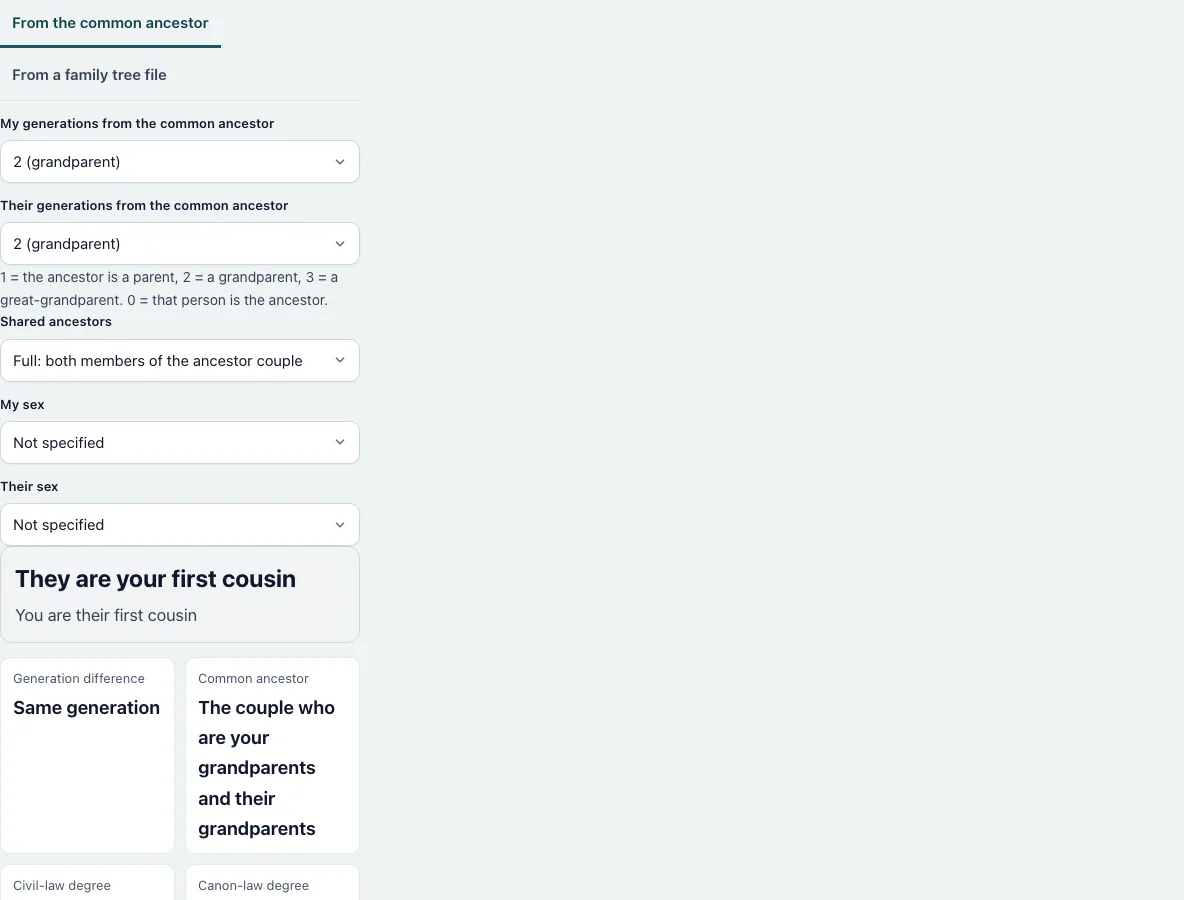
- On the first tab, set “My generations from the common ancestor”. The number counts steps up from you: 1 is a parent, 2 a grandparent, 3 a great-grandparent. Choose 0 if you yourself are the ancestor.
- Set “Their generations from the common ancestor” the same way, counting down from the ancestor to the other person. Choose 0 if they are the ancestor.
- Pick “Full” if the two lines meet at a couple, or “Half” if they share only one ancestor. Half is switched off when one person is a direct ancestor of the other.
- Optionally set “My sex” and “Their sex” so the answer says aunt or uncle instead of “uncle or aunt”.
- Read the big answer, then the tiles: generation difference, common ancestor, degrees and coefficient. “Copy the answer” puts a one-line summary on the clipboard.
- To use a real tree, open “From a family tree file”. Drop a .ged file, or press “Try the sample family”.
- Pick “Person A” and “Person B”. Type part of a name in the search box to narrow the list.
- Each relationship found appears as a card with its path from person A, flags such as step, half, adopted or by marriage, and degrees. “Copy all relations” copies them as text.
How do you calculate how two people are related?
Find the closest ancestor you share, then count the generations from that ancestor down to each person. Call your count a and theirs b. When a = 1 and b = 1 you share a parent, so you are siblings. When a = 2 and b = 1 the shared ancestor is your grandparent and the other person is that grandparent’s child: your aunt or uncle. When a and b are both 2 you are first cousins. Cousin degree is the smaller count minus one, and the “removed” number is the difference between the counts, so a = 3 and b = 4 gives second cousins once removed.
What is the degree of relationship?
The civil-law (Roman) degree is a + b: siblings are 2, an uncle is 3, first cousins are 4. The canon-law degree counts only the longer line, max(a, b): siblings are 1, an uncle 2, first cousins 2. Korean chonsu and the Japanese shintō count follow the civil count, so first cousins are 4촌 and 4親等. Laws differ on which method applies, so check the one your rule names.
What is the coefficient of relationship?
It is the expected share of genes two relatives have from common ancestors. Each shared ancestor adds a path of probability 1/2 for every step. Full siblings have two shared parents, so 2 x (1/2)^2 = 50%. An uncle is 25%, first cousins 12.5%, second cousins 3.125%. A parent or grandparent has a single path: 50% and 25%. Half relatives share one ancestor, so they get half of the full value: half siblings 25%.
Where do the numbers stop being exact?
The figures are averages by descent, not DNA results; actual shared DNA varies. They also assume the two lines meet only at the ancestors you chose. In file mode the answer is limited to people and links that are in the file, and older or younger siblings are read from birth dates. Cousins who married, or relatives who are linked in more than one way, get several results, listed best first.
Frequently asked questions
How are first cousins related?
First cousins share a grandparent couple. Each is two generations below that couple, so the civil degree is 4, the canon degree is 2 and they share about 12.5% by descent.
What does “once removed” mean?
It means the two people are in different generations. Your parent’s first cousin is your first cousin once removed: the generation counts differ by one. Twice removed means they differ by two.
Can I find how two people in my family tree are related?
Yes. Open the second tab, load a GEDCOM file and pick both people. The calculator lists blood relations, in-laws, step relations and flags adopted links.
What is the difference between half and full relatives?
Full relatives share both members of the ancestor couple. Half relatives share only one person, for example a common father but different mothers, and their coefficient of relationship is half as large.
Is my family tree uploaded anywhere?
No. The file is read in your browser and nothing is sent to a server.
Why does the answer say “uncle or aunt”?
You did not give their sex. Choose Male or Female under “Their sex” and the answer becomes uncle or aunt, nephew or niece, grandson or granddaughter.
Why is the canon-law degree smaller than the civil-law degree?
Canon law counts only the longer of the two lines to the common ancestor, while the civil method adds both lines together. For first cousins that gives 2 against 4.
Use these pages when you need a narrower answer or a different view of the same relationships.
- Cousin Calculator: find the degree and removal of two cousins.
- Cousin Chart: see every cousin degree and removal in one table.
- First Cousin Once Removed: check how this specific cousin relationship works.
- Relationship Chart: the classic chart of siblings, aunts, uncles, nieces and cousins.
- Kinship Terms: the same relatives in other languages.
- Inbreeding Coefficient Calculator: the chance of shared ancestry between parents.
- Ahnentafel Number Calculator: number your ancestors.
- How Many Ancestors Calculator: count ancestors by generation.
- GEDCOM Viewer: look at a file before you pick people.