Soundex Calculator
Paste surnames, one per line, to get four phonetic codes for each and the groups of names that share a code. Or compare two names directly.
Recent
Your last 10 settings, saved only in this browser. Nothing is uploaded.
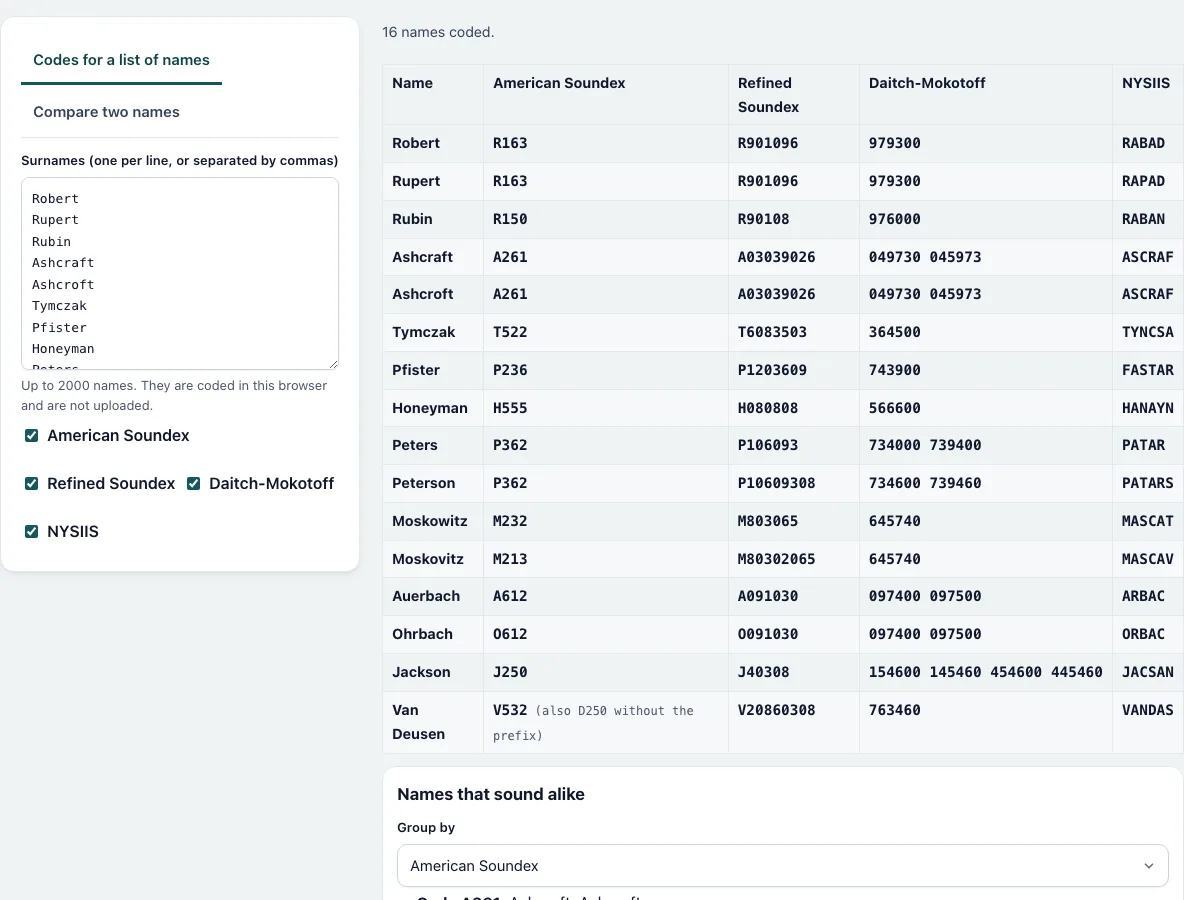
How to use the soundex calculator
- Open the tab “Codes for a list of names”. A list of sample surnames is already in the box.
- Replace it with your own names under “Surnames (one per line, or separated by commas)”. The table updates as you type. Up to 2000 names are coded.
- Read the columns “American Soundex”, “Refined Soundex”, “Daitch-Mokotoff” and “NYSIIS”. Use the checkboxes under the box to hide the ones you do not need.
- A name with several Daitch-Mokotoff codes shows all of them side by side. A name written with a prefix word, such as “Van Deusen”, shows a second American Soundex code for the name without the prefix.
- Scroll to “Names that sound alike”. Under “Group by” choose a method. Each group lists the names that share one code.
- Press “Copy table” to paste the codes into a spreadsheet, or “Download CSV” to save them as a file.
- A line without any letter from A to Z shows “no letters” in the code columns instead of codes.
- To test two spellings, open “Compare two names” and type them into “First name” and “Second name”. The table shows the codes of both and “Match” or “No match” for every method.
How is a Soundex code made?
American Soundex keeps the first letter and replaces the following consonants by digits: B, F, P, V give 1; C, G, J, K, Q, S, X, Z give 2; D and T give 3; L gives 4; M and N give 5; R gives 6. Vowels and Y are dropped but they separate letters with the same digit. H and W are dropped and do not separate. The code is cut or padded with zeros to four characters. Robert and Rupert both give R163, Ashcraft gives A261 because the H does not separate S and C, and Tymczak gives T522 because the A separates Z and K.
What is the difference between Soundex and Daitch-Mokotoff?
Daitch-Mokotoff has six digits, codes the first letter, and has rules for letter groups such as SCH, TZ or CH. A name that can be pronounced in more than one way gets several codes. Peters gives 734000 and 739400. Moskowitz and Moskovitz both give 645740, while American Soundex gives them M232 and M213. Two names match when they share at least one code.
What is NYSIIS?
NYSIIS gives a code made of letters, not digits. This page uses the Apache Commons Codec version of the algorithm, which cuts the code to 6 characters. Robert gives RABAD.
What is Refined Soundex?
Refined Soundex gives a digit for every letter, vowels as 0, merges repeated digits and has no fixed length. Robert gives R901096.
Which method should I use?
Each method misses some spellings and joins some unrelated names. Use American Soundex to match the US census indexes. Try Daitch-Mokotoff for Eastern European Jewish names.
How do I search an index with a Soundex code?
Work out the code of the surname you want, then look for that code instead of the spelling. All names with the same code are returned, so Robert and Rupert are found together. Because the code is only a guess at the sound, also search the neighbouring spellings. If the name has a prefix such as “Van Deusen”, the calculator shows the code with and without it, because indexes may file the name under either. For names from Eastern Europe, also compare the Daitch-Mokotoff codes.
Frequently asked questions
How do I find the Soundex code of a surname?
Type the surname into the list. The column “American Soundex” shows the letter and three digits, for example Smith S530.
Does the page treat Mc and Mac as prefixes?
No. Only a separate word Van, De or La at the start gives the second code, as in “Van Deusen”. Names typed as one word, such as VanDeusen or McDonald, get one code.
Why does one name have two Daitch-Mokotoff codes?
Some letters and letter groups, for example CH, J or RS, can be said in two ways. The calculator keeps both, and two names match if one code is shared.
Can two different names have the same code?
Yes. Smith, Smythe and Schmidt all give S530. Always check the records found by a code.
Does it work with accents and other alphabets?
Accented Latin letters are reduced to plain letters for American Soundex, Refined Soundex and NYSIIS. Daitch-Mokotoff has its own letter table, including some Polish and Romanian letters. Other alphabets are not coded.
Why do Smith, Smyth and Smid get the same code?
American Soundex drops vowels and Y and gives T and D the same digit 3, so all three give S530. The code keeps only the sound classes of the consonants.
Are my names stored?
No. The codes are made in your browser and nothing is sent anywhere.
- Age At Death Calculator: work out birth years from ages in census records.
- Ahnentafel Number Calculator: number the ancestors you find.
- How Many Ancestors Calculator: how many ancestors to search for per generation.
- Gedcom Viewer: open a family tree file and browse its names.
- Gedcom To Csv: export names from a tree to check them here.
- Kinship Terms: relationship words in other languages.
- Julian To Gregorian Converter: convert old dates found with the names.