Yahrzeit Calculator
Enter the Gregorian or Hebrew date of death and get the yahrzeit dates for the next years, ready to copy, print or add to your calendar.
Recent
Your last 10 settings, saved only in this browser. Nothing is uploaded.
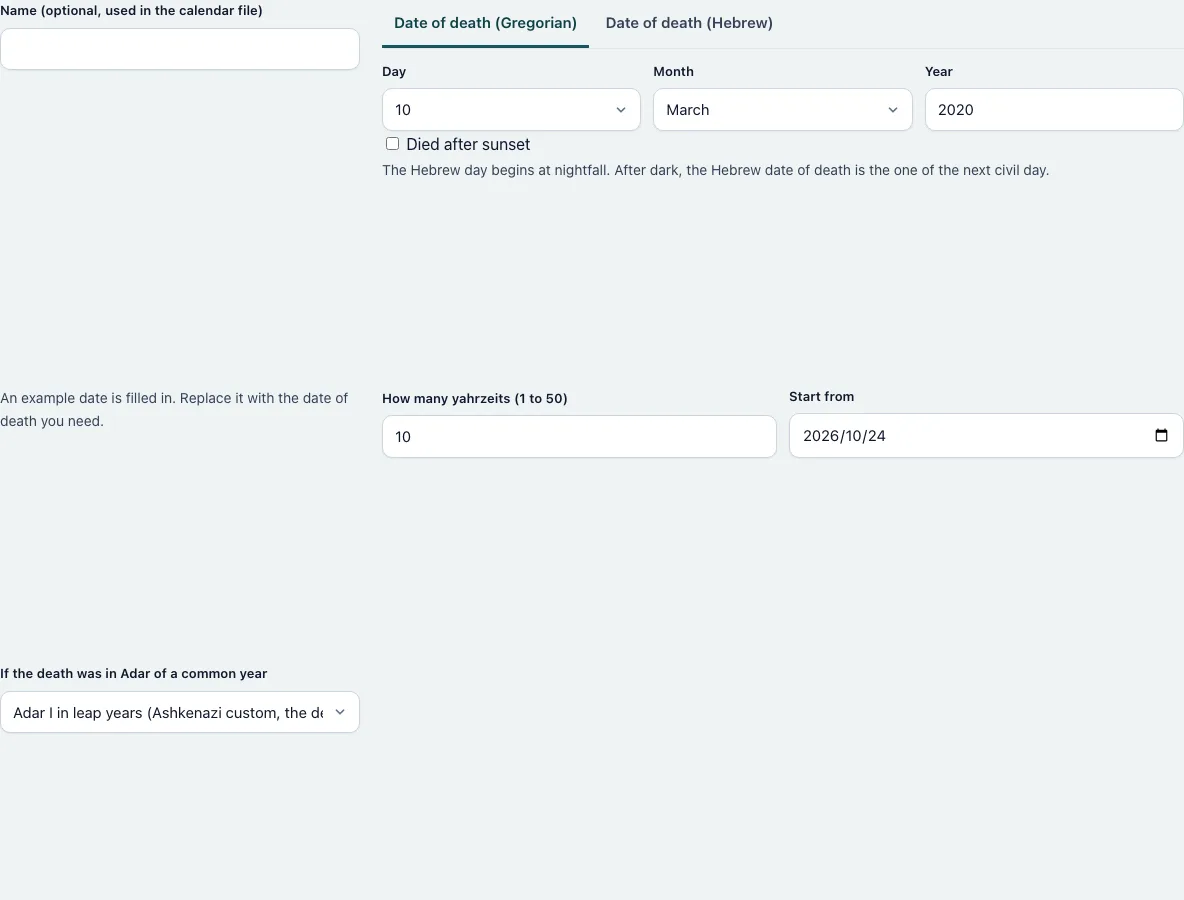
- Type a name if you want it in the calendar file. This is optional and stays on your device.
- In the tab “Date of death (Gregorian)”, choose the day and month and type the year. An example date is filled in, so replace it.
- Tick “Died after sunset” if death came after nightfall. The Hebrew date of death is then the next day’s date.
- If you know the Hebrew date instead, for example from a gravestone, open “Date of death (Hebrew)” and choose the Hebrew month, day and year. Adar II is only listed in leap years.
- Set “How many yahrzeits” between 1 and 50, and “Start from” to the day the list should begin. It starts on today’s date.
- If the death was in Adar of a common year, a further list appears. Choose Adar I, Adar II or both for the leap years.
- Read the result: the Hebrew date of death and the table. The column “Light the candle on the evening of” gives the civil date of the evening before the yahrzeit.
- Press “Copy the list” to paste plain text into an email, “Print” for paper, or “Download calendar file (.ics)” for one all-day event per yahrzeit.
When is the yahrzeit?
The first yahrzeit is in the Hebrew year after the year of death, on the same Hebrew month and day. After that it comes every Hebrew year. The date moves in the Gregorian calendar. Example: a death on 10 March 2020 is 14 Adar 5780. The first yahrzeit, 14 Adar 5781, is Friday 26 February 2021.
When do you light the candle?
A Hebrew day starts at nightfall, so the yahrzeit starts at sundown on the evening before the date shown. For 26 February 2021 that is the evening of 25 February. The tool shows the civil date of that evening but does not know your local sunset time.
What if death came after sunset?
The Hebrew date of death is then the date of the next civil day. A death on the evening of 2 October 2024 is 1 Tishrei 5785, and the yahrzeits follow 1 Tishrei.
Which rules apply to Adar, Cheshvan and Kislev?
Cheshvan and Kislev sometimes have 29 days instead of 30. A death on the 30th is observed on the last day of the month when the first anniversary year has no 30th. In a later year without a 30th it moves to the 1st of the next month. A death on 30 Adar I is observed on 30 Shevat in a common year. A death in Adar II is observed in Adar II in leap years and in Adar in common years.
What about Adar in a common year?
When a death was in Adar of a common year, leap years have two Adars and customs differ. The default is Adar I, which is the rule in Calendrical Calculations by Reingold and Dershowitz. Sephardi custom uses Adar II, and some authorities observe both. For the death of 10 March 2020, the yahrzeit in 5782 is 15 February 2022 in Adar I, 17 March 2022 in Adar II.
What does the calendar file contain?
The .ics file has a VCALENDAR with one all-day VEVENT for each yahrzeit. The event is on the civil day of the yahrzeit, and its description names the evening to light the candle.
Frequently asked questions
What is a yahrzeit?
A yahrzeit is the yearly anniversary of a death, counted by the Hebrew calendar. The word is Yiddish, and many families keep the day with a memorial candle. Observance varies between communities.
Why does the Gregorian date change every year?
The Hebrew year is not the same length as the Gregorian year, and leap years add a month. The Hebrew date stays fixed, so the Gregorian date moves.
Is the first yahrzeit one year after the death?
In this calculator it is on the same Hebrew date in the Hebrew year after the year of death. A death shortly before Rosh Hashanah therefore has its first yahrzeit a few weeks later. Ask your rabbi if your community counts it differently, for example by waiting until a full year has passed.
Can I enter a Hebrew date of death directly?
Yes. Use the Hebrew tab. This is the exact way to enter a death after sunset, because you give the date as it was in the Hebrew calendar.
Which custom should I choose for Adar?
The page uses Adar I by default for a death in Adar of a common year, as Hebcal does. If your family follows the Sephardi custom, choose Adar II. Your rabbi can tell you which applies.
- Hebrew Date Converter: convert any single date between the Hebrew and Gregorian calendars, in both directions.
- Age at Death Calculator: work out the age at death from two dates.
- 49 Days After Death Calculator: Buddhist memorial dates from a date of death.
- Julian to Gregorian Converter: convert older dates written in the Julian calendar.
- Ahnentafel Number Calculator: number the ancestors in your tree.
- GEDCOM Viewer: read the dates in a GEDCOM file.
- Soundex Calculator: match spellings of a surname in old records.